
How Do Privacy Window Films Work? A Complete Guide
How Does Privacy Window Film Work? A Complete Guide
Large windows and glazed doors are fantastic for bringing natural light into a property, but there is an obvious trade-off: the easier it is to see out, the easier it may be for other people to see in.
This can be particularly noticeable in street-facing living rooms, ground-floor offices, bathrooms, bedrooms and properties situated close to neighbouring buildings.
Privacy window film provides a way of changing how people see through existing glass without necessarily replacing the window or permanently covering it with curtains or blinds.
But how does privacy window film actually work? And can you really have a window that allows you to see outside while preventing other people from looking in?
The answer depends on the type of film you choose.
At PR Solar Window Film, we supply and professionally install privacy window film for residential and commercial properties. In this guide, we’ll explain the principles behind the technology and the important differences between reflective, one-way and frosted privacy films.
What Is Privacy Window Film?
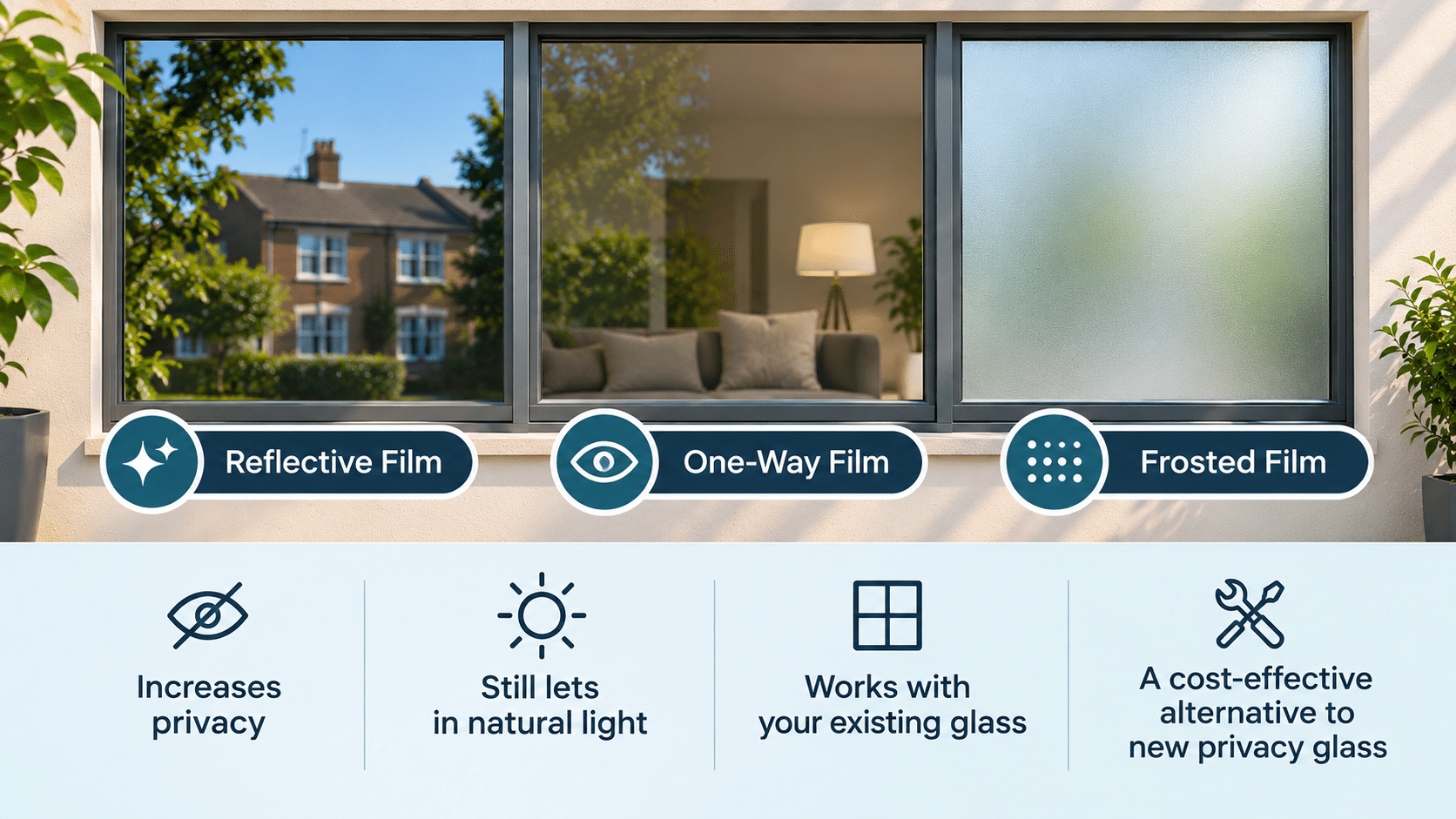
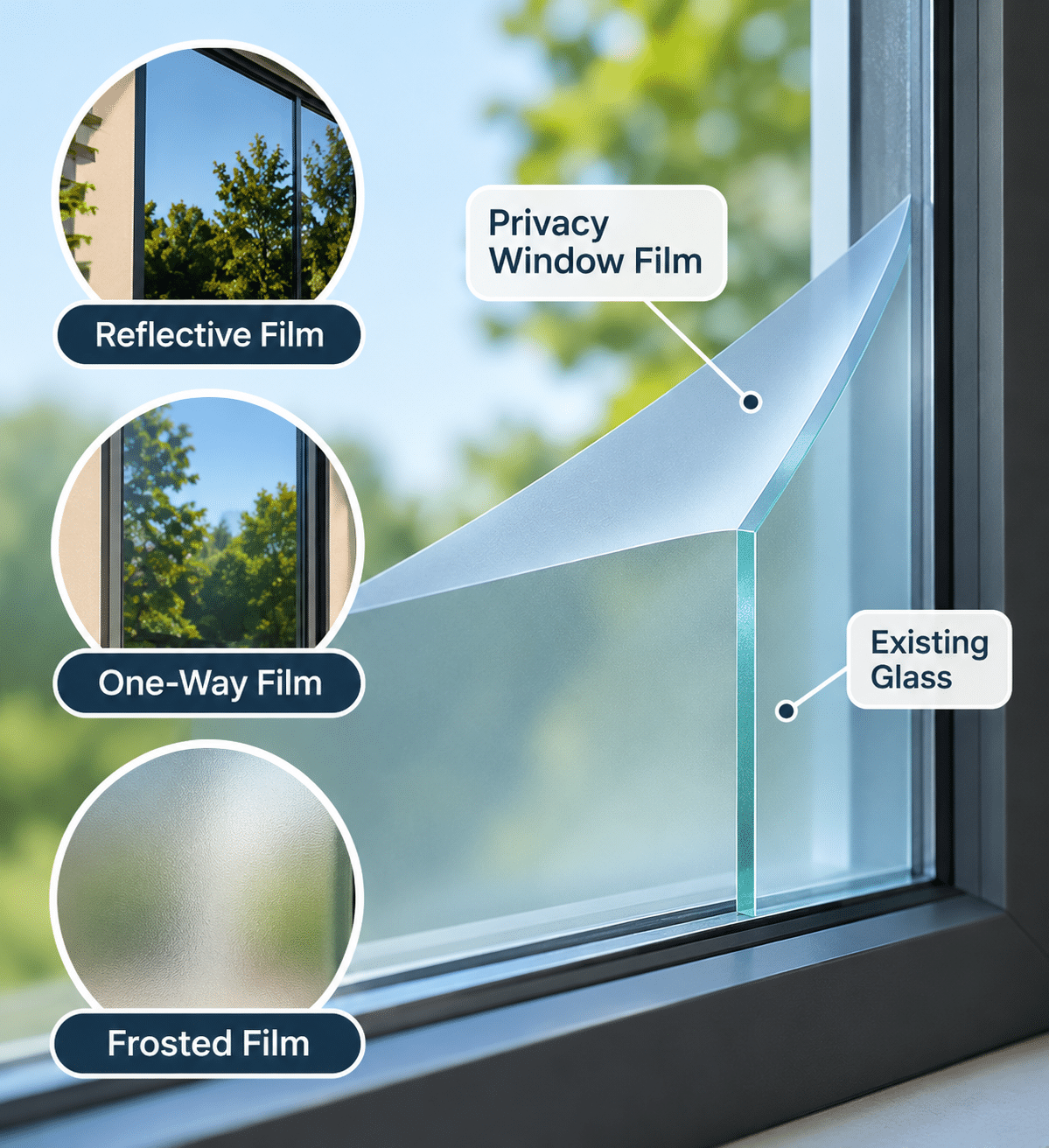
Privacy window film is a thin layer of specialist material professionally applied to existing glass to alter its appearance and visibility.
Rather than replacing an entire window with obscured or specialist privacy glass, film allows the characteristics of existing glazing to be changed.
There are several ways of achieving this.
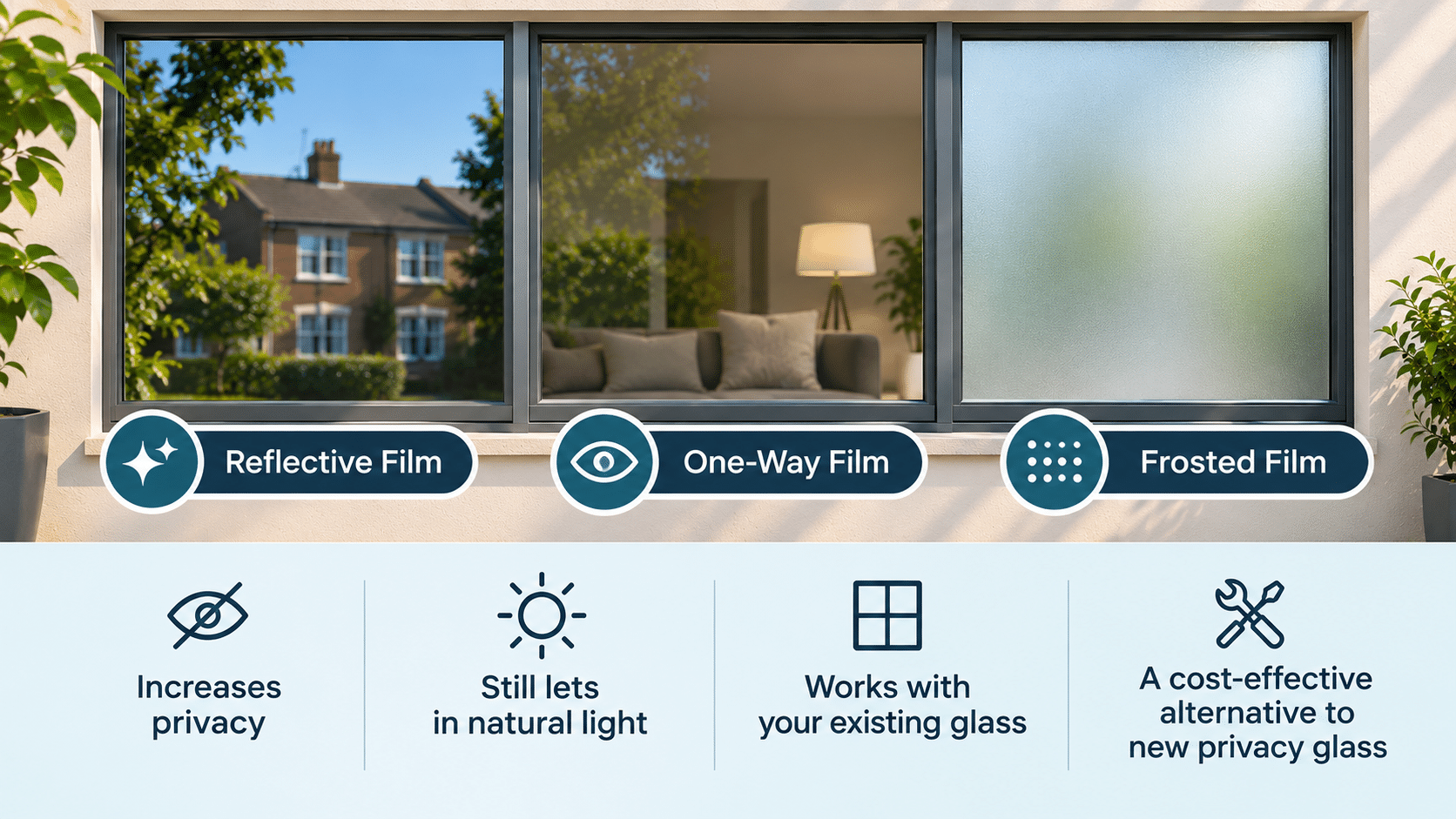
Some films create a reflective surface that reduces the ability to see through the glass from the brighter side. Others produce a frosted or obscured appearance that diffuses light and prevents a clear image being seen through the window.
Understanding this distinction is important because these films don’t all provide privacy in the same way.
How Does One-Way Privacy Window Film Work?
“One-way window film” is a popular term, but it can give the slightly misleading impression that the glass permanently works in one direction.
In reality, reflective privacy film relies heavily on differences in light levels.
Imagine a street-facing living-room window during the daytime. Outside, there may be bright daylight, while the interior of the house is considerably darker.
Reflective film makes the brighter side of the glass appear much more mirror-like. Someone walking past therefore sees predominantly the reflected exterior environment rather than getting a clear view into the darker room.
From inside, however, occupants can still retain visibility through the glazing.
This makes reflective privacy window film particularly useful where you want daytime privacy without permanently sacrificing your view outside.
Frequently Asked Qustions
This is probably the most important thing to understand before choosing reflective privacy film.
One-way reflective privacy film cannot normally provide the same privacy at night when the room is brightly illuminated and it is dark outside.
That’s because the relationship between the light levels has changed.
During the day:
Outside = brighter
Inside = darker
The reflective privacy effect therefore works in your favour.
At night with the lights switched on:
Inside = brighter
Outside = darker
Someone outside may consequently be able to see into the illuminated room.
The effect hasn’t mysteriously stopped working; the lighting conditions responsible for producing the daytime privacy effect have effectively reversed.
For this reason, curtains or blinds may still be required at night where a clear outward view is important during daylight hours.
If you require privacy both day and night, a different type of film may be more appropriate.
Frosted window film takes a completely different approach.
Rather than relying on one side of the window being brighter than the other, it obscures the view through the glass.
The frosted surface diffuses and scatters transmitted light, preventing a clear image from being seen through the treated area while still allowing natural daylight to enter.
This is similar in principle to traditional obscure or frosted glass, except the effect is applied to existing glazing.
Because it doesn’t depend on a favourable difference between indoor and outdoor light levels, frosted film can provide privacy during both the day and night.
The trade-off is that you generally won’t retain the same clear view through the treated section of glass.
Neither is inherently better. They solve different problems.
If you have a street-facing living room and want to see outside during the daytime without passers-by easily looking in, reflective privacy film may be an excellent solution.
If you’re treating a bathroom window, being able to see clearly outside is usually far less important than maintaining dependable privacy. Frosted film may therefore make more sense.
The same principle applies in commercial properties.
Reflective privacy films can be useful on external office windows where daytime privacy and outward visibility are important, whereas frosted films work particularly well on meeting rooms, glass partitions and private offices where obscuring sightlines is the priority.
This is why we prefer to understand how a particular window is used before recommending a solution.
Privacy doesn’t necessarily mean darkness.
One of the major reasons people consider window film is that they don’t want to keep curtains or blinds closed throughout the day simply to stop people looking through their windows.
Different privacy films transmit different amounts of visible light, so the exact result depends on the film selected.
Frosted films, for example, can obscure detailed views while continuing to allow diffuse daylight into the room. Reflective films can also provide privacy without completely eliminating natural light or the view outside.
This can be especially valuable in smaller rooms where permanently closed blinds could make the space feel dark or enclosed.
Privacy film can be applied in many residential and commercial situations.
In homes, common applications include bathrooms, bedrooms, front doors, door sidelights, ground-floor rooms and street-facing windows.
Consider a terraced property where the living-room window sits only a short distance from the pavement. Keeping curtains closed all day provides privacy, but it also blocks the daylight. A suitable privacy film can offer a more practical compromise.
Commercial applications can include offices, meeting rooms, reception areas, internal glass partitions and external-facing workplace windows.
The right solution ultimately depends on what you’re trying to achieve: daytime privacy, permanent obscuration, retained outward visibility or simply a greater sense of separation between spaces.

Is Privacy Window Film Right for Your Property?
The most important question isn’t simply whether privacy window film works. It’s what type of privacy you need.
If your priority is stopping passers-by looking into your home during daylight hours while retaining a view outside, reflective privacy film may be appropriate.
If you need dependable privacy during the day and night and don’t require a clear view through the treated glass, frosted film is often the more suitable approach.
At PR Solar Window Film, we take a consultative approach rather than assuming the same privacy film is right for every window. We can assess the glass, understand how the room is used and discuss the level of privacy and natural light you want before recommending a suitable option.
We provide professional installation for homes, offices and commercial properties, with free site visits available to assess and measure your windows.
If you’d like to explore the options, learn more about our privacy window films or contact us for a free quotation.